



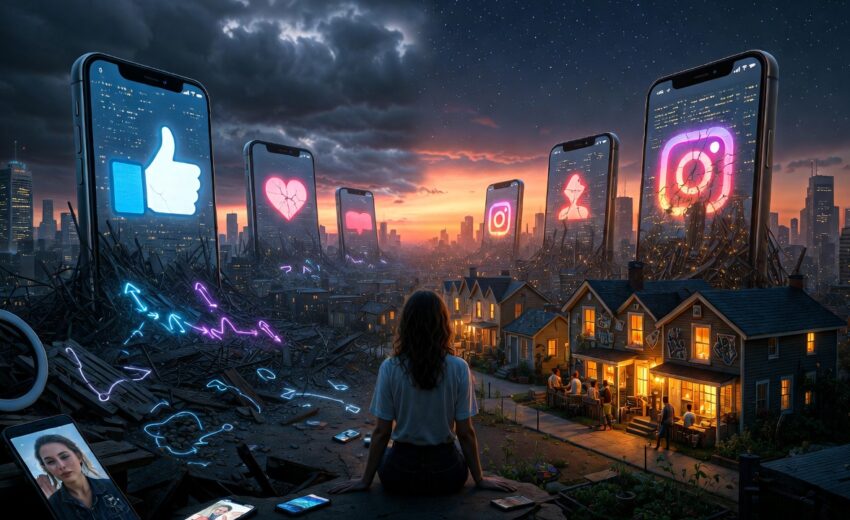
Social Media Is Dying — What Replaces It Will Be Unrecognizable
Bold predictions for the future of digital culture, online identity, and the platforms that shape how three billion people think, feel, and relate to each other
Something died in 2022 and we’re still in denial about it.
Not social media itself — not yet. But the idea of social media. The original dream. The one that said connecting the world’s people on shared platforms would create understanding, accelerate democracy, amplify marginalized voices, and build a global village that Marshall McLuhan could only gesture at from the 1960s. That dream — naive as it probably always was — is definitively, measurably, statistically dead.
What replaced it is something stranger and more complicated: a set of platforms that are simultaneously more powerful than anything in the history of human communication and more corrosive to the things that make communication valuable. Platforms that connect billions while making most of them lonelier. That give everyone a voice while making it harder to be heard. That promised authenticity and delivered performance. That said they would connect you to the people you care about and instead connected you to algorithmic strangers whose content is optimized to keep your thumb moving.
We’re three billion users deep into an experiment that nobody consented to, and the results are coming in. They are not good. And the platforms — the ones left standing after the great social media shakeout of the past three years — are responding not by fixing what’s broken but by doubling down on what’s profitable, which is an entirely different thing.
Here’s what I think is actually coming. Not what the platforms want you to believe is coming. Not the sanitized roadmap vision presented at developer conferences. What I actually think is going to happen, based on where the culture is moving, where the money is moving, and where three billion increasingly exhausted users are pushing back.
Buckle in. Some of this is going to make you uncomfortable. Some of it might make you hopeful. Most of it is probably already happening around you in ways you haven’t quite named yet.
Prediction One: The Age of Mega-Platforms Is Over — They Just Don’t Know It Yet
Facebook has 3 billion monthly active users. YouTube has 2.7 billion. Instagram has 2 billion. These numbers are so large they have become almost meaningless — a rounding error on human civilization, a statistic that obscures more than it reveals.
Here’s what the numbers don’t tell you: engagement at the emotional core — the feeling of genuine connection, discovery, and community that made these platforms addictive in the first place — has been declining for years. Users are still on the platforms. They’re spending time. But the quality of that time, the sense that something real is happening, has quietly hollowed out.
The reasons are structural and I don’t think they’re fixable. The mega-platforms became too big to serve any community well. When your platform has two billion users, the algorithm can’t prioritize your genuine interests — it has to find the lowest common denominator of engagement, which is almost always outrage, anxiety, aspiration, or prurience. The content that performs best is almost never the content that leaves you feeling good about having seen it. And after years of this, users have internalized the transaction. They know they’re being manipulated. They resent it. They keep scrolling anyway, but the resentment is real and it’s accumulating.
The generation that grew up on Instagram — now in their mid-to-late twenties — has reached a kind of collective exhaustion with the performance of it. The curated life. The follower count as social currency. The way the platform incentivizes you to package your genuine experiences into content that other people will engage with, which over time makes the experiences themselves feel like raw material rather than life. The backlash is quiet but it’s real. These users aren’t leaving Instagram — they’re using it differently. More privately. More ironically. With more deliberate distance from the original proposition.
My prediction: within five years, we will look back at the era of three-billion-user platforms the way we now look back at the era of three major television networks. A brief period when technology forced everyone into the same channels, followed by fragmentation into something much more diverse and much more suited to actual human needs. The mega-platforms will still exist — they’ll be too embedded to disappear — but their cultural centrality will fade. They’ll become utilities rather than destinations. Infrastructure rather than experience.
The interesting action will be elsewhere.
Prediction Two: The Future Is Small, Private, and Intentional
Here is the most important trend in digital culture that almost nobody in mainstream tech media is covering adequately: the mass migration to small, private, intentional online communities.
Discord servers with a few hundred members built around hyper-specific interests. WhatsApp and Telegram groups that function as genuine communities of practice. Substack comment sections that have more intellectual vitality than any equivalent Twitter thread. Private Slack communities for professional niches. Group chats that have been running for years and have developed their own culture, their own in-jokes, their own norms.
This is not a new phenomenon — it’s a return to something that was always more natural to humans. We are not, as a species, designed to perform for strangers at scale. We are designed to maintain meaningful relationships with groups of roughly 150 people (Dunbar’s number, which has held up reasonably well in subsequent research). The mega-platform experience — broadcasting to an indeterminate audience of followers, optimizing for likes from people you’ve never met, curating a persona for thousands of simultaneous observers — is deeply unnatural, and we are now, collectively, figuring that out.
The smart money in social technology right now is not on the next big public platform. It’s on the tools that make small, private communities better. Better organized. Better moderated. Better able to develop their own culture and norms. Better at connecting the right people with the right depth of conversation rather than the right people with the highest engagement metrics.
What does this mean for digital culture at large? It means the next significant cultural movements — the aesthetic shifts, the political energies, the intellectual fashions — are increasingly going to originate in private or semi-private communities and leak out into public consciousness rather than erupting on public platforms. The cultural influence of Twitter/X, which for a decade was the place where ideas caught fire and spread, is diffusing. The ideas are still catching fire — just in places that are harder to observe, harder to co-opt, and consequently more authentic.
This is genuinely good news for culture. Monocultures are brittle. A digital landscape of thousands of thriving small communities is more resilient, more diverse, and more hospitable to genuine human flourishing than one dominated by three companies whose algorithms are optimized for engagement metrics.
It is, however, terrible news for advertisers, for political propagandists, for anyone whose strategy depends on reaching large audiences efficiently through social channels. The fragmentation of attention that the small-community shift represents is a genuine crisis for the business models built around mass social media reach. And the platforms are going to fight it. Hard.
Prediction Three: AI-Generated Content Will Break the Internet — Then Force It to Rebuild
Here is the prediction that I think about most, because I think its implications are the most profound and the least understood.
The volume of AI-generated content on the internet is already staggering. It’s in the marketing emails you receive. It’s in the product descriptions you read. It’s in the news summaries, the SEO articles, the social media posts from brands, the customer service responses, the comment sections of websites you visit. And it is about to get dramatically larger.
The economic logic is inescapable. Producing content with AI costs a fraction of what human-produced content costs. The quality — for many content categories — is indistinguishable from average human production. The volume is essentially unlimited. Every organization that produces content at scale, from the largest media company to the smallest e-commerce operation, has a financial incentive to replace human content production with AI wherever the quality threshold allows.
The result, within the next two to three years, is going to be a internet so saturated with AI-generated content that the experience of consuming online content changes fundamentally. Not because any individual piece of AI content is bad — much of it will be perfectly adequate. But because the sheer volume, and the speed with which it can be produced to target any trend or search query, will make the entire information landscape feel different. Less trustworthy. Less surprising. Less human.
And this creates a fascinating cultural dynamic that I think will reshape social media profoundly.
Human attention — specifically, the attention of humans who are aware that most of what they encounter online is AI-generated — will shift dramatically toward signals of genuine human origin. The imperfect photo taken on a cheap phone will be more valuable than the AI-perfected image, because it’s real. The unpolished, slightly rambly personal essay will outperform the smooth AI narrative, because you can feel the person in it. The live, unscripted video where someone stumbles over their words will carry more weight than the perfectly edited production, because the stumble is proof of humanity.
We are about to see, I predict, the rise of what I’ll call authenticity premiums — situations where the demonstrably human origin of content becomes a significant part of its value. Platforms that can credibly certify human-generated content will have a competitive advantage. Creators who can demonstrate genuine lived experience, genuine expertise, genuine personality — rather than just competent content production — will command attention that AI cannot replicate.
This is going to be a messy transition. There will be fraud — people claiming AI content is human, people trying to create AI that better mimics human imperfection. There will be false positives — genuine human content flagged as AI because it happens to be well-organized and clearly written. The tools for distinguishing human from AI content are not reliable, and may never be fully reliable.
But the cultural pressure toward demonstrable authenticity is real and will intensify. The backlash against AI content is already forming. Within five years, “written by a real person” will be a meaningful differentiator in content marketing — the same way “organic” became a differentiator in food, for similar reasons, with similar complications around verification.
Prediction Four: The Creator Economy Will Consolidate, Brutally
The creator economy — the ecosystem of independent content creators making a living through platform monetization, brand deals, subscriptions, and merchandise — is real, significant, and headed for a painful consolidation that the people inside it are not adequately prepared for.
Here’s the math that most creator economy coverage glosses over: the distribution of income in the creator economy follows a power law so extreme it makes the income distribution in the broader economy look egalitarian. A tiny fraction of creators — the top fraction of a percent — captures the vast majority of revenue. The middle class of creators, the people making a living but not a fortune, is narrower than the narrative suggests. And the bottom — the enormous base of aspiring creators who are investing real time and money into building audiences — is mostly not making meaningful income.
This has always been true to some degree. The creator economy is not different from the music industry or Hollywood in its essential structure — a few stars, a thin professional middle, and a vast amateur base. What’s different is the mythology around it: the persistent cultural narrative that “anyone can make it,” that the algorithm is a meritocracy, that with enough hustle and the right strategy any creator can build a sustainable audience and income.
That mythology is being stress-tested right now by three simultaneous pressures.
The first is AI content. When AI can produce adequate video scripts, thumbnails, social media posts, and even voiceovers at negligible cost, the creators whose value is primarily in efficient, competent content production face a floor-dropping-out-from-under-them moment. The YouTube explainer video that’s well-researched and clearly presented but impersonally delivered? AI can do that. The Instagram post that’s aesthetically consistent and well-captioned? AI can do that. The creator whose value is their specific perspective, their specific personality, their specific relationship with their audience — that’s a different conversation. But a lot of what the creator economy produces is not that.
The second pressure is platform algorithm volatility. The creators who have built audiences on specific platforms are discovering that those audiences are not really theirs — they’re rented from the algorithm. When TikTok changes its recommendation logic, careers end. When YouTube adjusts its monetization policies, business models collapse. When Instagram pivots toward Reels and deprioritizes static posts, photographers find their reach collapsed overnight. The platform owns the distribution, and creators are discovering how precarious that dependence is.
The third pressure is audience saturation. The total amount of attention available for creator content is not infinite, and the supply of creator content has grown faster than the attention supply. The competition for eyeballs has intensified to the point where the content quality required just to be visible has increased dramatically, while the average revenue per viewer has declined as platforms take larger cuts and advertising markets fragment.
The consolidation I’m predicting will look like this: the top tier of creators — those with genuine, irreplaceable personality and deep audience relationships — will thrive and expand. They’ll diversify revenue, build direct relationships with audiences through owned channels (newsletters, memberships, their own apps), and become genuinely sustainable independent media businesses. The bottom tier will largely exit, either quietly giving up on monetization or finding that the audience they’ve built doesn’t translate to meaningful income. And the middle — the professional but not famous creator — will face the hardest choices.
The smart creators are already making the right moves. Building email lists. Launching paid memberships. Diversifying across platforms rather than betting on one. Investing in audience relationships rather than audience size. These are not new strategies — they’re the strategies of sustainable media businesses — but the creator economy has been slow to adopt them because the platform gravy train made them seem unnecessary.
The gravy train is slowing down.
Prediction Five: Digital Identity Will Fracture Into Multiple Selves
One of the stranger things about the early era of social media was its insistence on singular identity. Facebook’s original and fiercely enforced real-name policy embodied a philosophy: you are one person, your identity is fixed and public, and your online life should reflect your offline life transparently.
This philosophy has been losing the argument for a decade, and I think it’s about to lose it definitively.
Human beings do not have singular, fixed identities. We present differently in different contexts — to our employers, our families, our close friends, our casual acquaintances, our romantic partners, our online communities of interest. This is not duplicity. It is the normal, healthy operation of social identity in a complex world. The sociologist Erving Goffman described this as “impression management” in 1959, and nothing about the internet has changed the underlying psychology even as it has complicated the performance.
The platforms that are growing — that feel most natural to the humans using them — are the ones that accommodate this contextual identity rather than fighting it. TikTok’s separation between your public persona and your private watch history. BeReal’s attempt to capture authentic rather than curated moments. The prevalence of anonymous or pseudonymous accounts on almost every platform, maintained by people who have public, named accounts elsewhere. Discord’s server-specific personas.
The trend I see accelerating is deliberate identity fragmentation. Not in a pathological way, but in the way that people have always naturally compartmentalized their social lives, now enabled by digital tools that make compartmentalization easy and explicit. Your professional identity on LinkedIn. Your interests identity on niche community platforms. Your personal identity in private group chats. Your creative identity on a pseudonymous account. Your local community identity on neighborhood apps.
Each of these contexts has different norms, different audiences, different versions of you — and increasingly, people are making deliberate choices about which version goes where, rather than trying to maintain a single coherent public persona that serves all contexts simultaneously.
This has significant implications for advertising (you can no longer assume the person you’re targeting in a professional context is the same as the person you’re targeting in an entertainment context). It has implications for political messaging (the assumption that you can characterize someone’s views based on one slice of their online life is increasingly wrong). It has implications for platform design (the platforms that try to know everything about you will be trusted less than the platforms that know only what you choose to show them).
And it has implications for culture. The singular public persona — the carefully maintained personal brand that the influencer era made into an aspiration — is going to look increasingly exhausting and artificial against a cultural backdrop that is moving toward contextual authenticity. Being different people in different contexts is not a bug. It’s the feature.
Prediction Six: The Attention Economy Will Face Its First Real Political Crisis
For twenty years, the business model of social media — capture attention, sell it to advertisers — has operated with remarkable political immunity. Governments have passed privacy laws, antitrust investigations have been opened and closed, hearings have been held and forgotten. But the core model has remained intact and largely unregulated in the ways that would actually change it.
I think that’s ending.
The evidence connecting heavy social media use — specifically, algorithmically optimized feed-based social media — to mental health deterioration, particularly in adolescents, has accumulated to the point where it is difficult to dismiss. The internal research from Facebook and Instagram, revealed in congressional testimony and subsequent leaks, showed that the companies knew about these effects and made product decisions that prioritized engagement over user wellbeing. That combination — documented harm, documented knowledge, documented choice to continue — is the structure of a public health and regulatory crisis.
The political momentum is building in ways that feel qualitatively different from previous waves of social media regulation anxiety. Multiple U.S. states have passed or are passing legislation restricting social media access for minors. The federal legislative appetite, historically limited by First Amendment concerns and lobbying, is more serious than it has been. The EU’s Digital Services Act has teeth that previous European digital regulation lacked, including requirements for algorithmic transparency and risk assessments for the largest platforms.
More importantly — and this is the thing that I think the platforms are most worried about — the parents of the affected generation are angry in a way that is politically potent. When the harm is abstract (privacy, manipulation, misinformation), it’s hard to organize around. When the harm is your teenager’s anxiety disorder, your daughter’s eating disorder, your son’s inability to function offline — that’s organizing material.
My prediction is that within three years, major social media platforms will face binding regulatory requirements in multiple major markets that directly constrain their core business model. Not mild transparency requirements. Actual constraints on algorithmic recommendation, on the addictive design patterns that keep users scrolling, on the targeting of minors, and possibly on the ad-targeting model itself.
The platforms will fight this. They have enormous lobbying resources and they will deploy them. But I think the political and cultural momentum has shifted past the point where they can hold the line indefinitely. The question is not whether regulation comes but what form it takes — and whether the form it takes actually addresses the underlying problems or just creates compliance theater while leaving the fundamental model intact.
Prediction Seven: A New Digital Culture Is Already Being Born in the Wreckage
This is the prediction I’m most uncertain about in its details and most confident about in its broad direction.
Something new is being built in the spaces that the mega-platform era left open and unoccupied.
The generation now entering their late teens and early twenties — the ones who grew up watching millennials burn out on Instagram, who saw the Twitter intellectual culture dissolve, who inherited a digital landscape already in visible decay — is not making the same bets their predecessors made. They are more skeptical of platforms. More protective of their attention. More deliberate about their digital lives. And they are building different things.
The aesthetics are different. Where the Instagram era prized polish, symmetry, and aspirational perfection, the emerging aesthetic in youth digital culture prizes rawness, specificity, and the authentic weird. Low-production-value content that feels real. Humor that is absurdist and self-referential in ways that require cultural fluency to decode — which is to say, humor designed to include people who get it and exclude people who don’t, the opposite of the lowest-common-denominator virality that mega-platforms reward.
The values are different. The performative activism and aesthetic virtue signaling that characterized the Instagram era — the carefully worded posts about social issues, the black squares, the hashtag campaigns — has been met with profound cynicism by the generation that watched it accomplish nothing. What’s replacing it is not apathy but a different relationship between belief and performance. More private. More action-oriented. Less interested in the performance of caring and more interested in actual effect.
The relationship to technology itself is different. The generation coming up is the first one that has a genuinely ambivalent, eyes-open relationship to social media. They use it — of course they do, it’s ambient infrastructure — but they use it with an ironic awareness of what they’re doing that previous generations didn’t have. They know they’re being manipulated. They know the algorithm is not their friend. They have internalized the critique of social media in a way that the generation that built the platforms never did.
What this generation builds — the platforms, the communities, the cultural forms, the norms around digital life — will be shaped by that awareness. Not perfectly. Not consistently. But directionally, toward something more intentional, more human-scaled, and more honest about the transaction than what came before.
I don’t know exactly what it will look like. Nobody does yet, because it’s being invented right now in Discord servers and group chats and small Substack communities and niche forums that most people in mainstream tech have never heard of. But I am confident that it will look less like Facebook and more like something we don’t have a good name for yet.
Prediction Eight: The Influencer Era Will End With a Cultural Reckoning
The influencer era — the period from roughly 2015 to the present in which a class of social media celebrities emerged who derived their income and cultural power from the attention of millions of followers — will be looked back on as one of the stranger chapters in the history of celebrity and commerce.
It will be strange because of the intimacy it simulated. Followers of major influencers often describe their relationship to these people in terms that would previously have applied only to close friends: “She feels like someone I actually know.” “I feel like we’ve grown up together.” “I trust his recommendations because I feel like he’s genuine.” The influencer model was built on this simulated intimacy — on the parasocial relationship that made followers feel like friends rather than audiences.
The parasocial relationship is not new — people have always felt connected to celebrities they’ve never met. What was new about the influencer era was the scale of the simulation and the commercial exploitation of it. When a follower buys a product recommended by an influencer they feel they know personally, the dynamic is different from seeing a celebrity in a traditional advertisement. It’s closer to a friend recommendation than an ad — and that’s exactly why it works, and exactly why it is, at some level, a deception.
The generation coming up is increasingly aware of this. The collapse of influencer credibility in recent years has been driven by scandals, but even more by a generalized skepticism that has grown as the model has become more visible. When you can see the seams — when you know that every “authentic” moment is potentially staged, that every product recommendation is potentially paid, that the “real” behind-the-scenes content is itself a content strategy — the spell breaks.
I predict the influencer model, in its current form, has less than five years of cultural centrality left. It will be replaced by something that looks more like genuine expertise, genuine community, and genuine accountability — or by nothing at all, as the attention that currently flows to influencers fragments into the smaller, more private communities I described earlier.
The reckoning will be cultural before it’s financial. The cultural appetite for the influencer as aspiration — the idea that building a following and monetizing it is a desirable life goal — is already visibly declining among the generation that would be the next cohort of influencer-aspirants. They have watched the burnout. They have watched the mental health crises. They have watched the constant content treadmill extract a price that the follower count doesn’t justify. They are making different choices.
The Through Line
Eight predictions, and a common thread running through all of them.
The era of social media that we have lived through — the era of mega-platforms, mass audiences, singular public identities, algorithmic manipulation, parasocial commerce, and performed authenticity — was not a stable resting point. It was a phase. A particular configuration of technology, business incentives, cultural naivety, and regulatory absence that produced something unprecedented and deeply strange.
That phase is ending. Not in one dramatic moment but in the gradual way that eras always end — at first slowly, then all at once.
What replaces it will not be a utopia. The problems of human communication — the tribalism, the cruelty, the susceptibility to manipulation, the challenge of building genuine understanding across difference — are not technological problems and will not be solved by better platforms. We will carry those problems into whatever comes next.
But the specific pathologies of the current era — the addictive scroll, the performative persona, the mass manipulation for advertising revenue, the hollowing out of genuine community in favor of follower counts — those are specific products of specific design choices and specific business models, and they will not survive the combination of cultural rejection, regulatory pressure, and technological change that is bearing down on them.
The digital culture being built in the spaces between — in the small communities, the private channels, the niche forums, the deliberately human-scale interactions — is not yet legible enough to fully describe. But it is there, and it is alive, and it is being built by people who have learned from what came before.
That, more than any specific platform or feature or business model, is the real story of where social media is going. Not a story about technology at all. A story about what people want when they’ve had enough of being manipulated, and what they build when they decide to do something different.
The question is whether you’ll be part of building it — or still waiting for the algorithm to tell you what to care about next.
This article represents one person’s read on where the culture is headed. I’ve been wrong before and I’ll be wrong again. If you think I’m missing something, the comment section is the place to make the case. The most interesting futures are the ones nobody predicted.